

• Payroll numbers rise for fourth straight month
• Modest reductions in activity and new orders
• Business confidence slips to five-month low
A modest decline in private sector activity across Scotland was accompanied by a further reduction in new business in September, the latest Royal Bank of Scotland Growth Tracker showed. Nevertheless, companies continued to expand their payrolls and at a strong pace.
The headline Royal Bank of Scotland Business Activity Index – a seasonally adjusted index that measures the month-on-month change in the combined output of Scotland’s manufacturing and service sectors – printed 48.8 in September, little-changed from 48.9 in August, and thereby indicating a modest reduction in Scottish private sector output. That said, the headline index has now posted in contraction territory for six successive months.
Anecdotal evidence linked the latest fall in activity to fewer new orders and the increased cost of living.
Scotland and the North West were the only two areas among the 12 monitored UK regions and nations to register declines in output, with Scotland posting the faster pace of reduction. Meanwhile, business activity growth across the UK as a whole eased to a modest pace that was the softest in three months.
Encouragingly, staffing levels across Scotland rose for a fourth consecutive month in September. Survey respondents linked the latest increase in workforce numbers to efforts to support future output growth.
Commenting on the Tracker’s findings, Judith Cruickshank, Scotland Board Chair, Royal Bank of Scotland, said, “Despite employment rising for a fourth consecutive month, Scottish firms signalled further declines in activity and new orders at the end of the third quarter.
“Business confidence also weakened as cost pressures continued to rise. Higher fuel costs, driven in large part by geopolitical tensions, were a key driver of inflation, alongside reports of increased raw material and labour expenses.
“With Scottish business activity seeing the fastest decline of any UK nation or region and with only Northern Ireland having lower business confidence, it is difficult to see how the current trend of rising employment will be sustained unless activity and sentiment improve. As our recent mid-market report found, one way to address this and deliver growth is for government and industry to support mid-market businesses in three key areas – tech, talent and trade.”
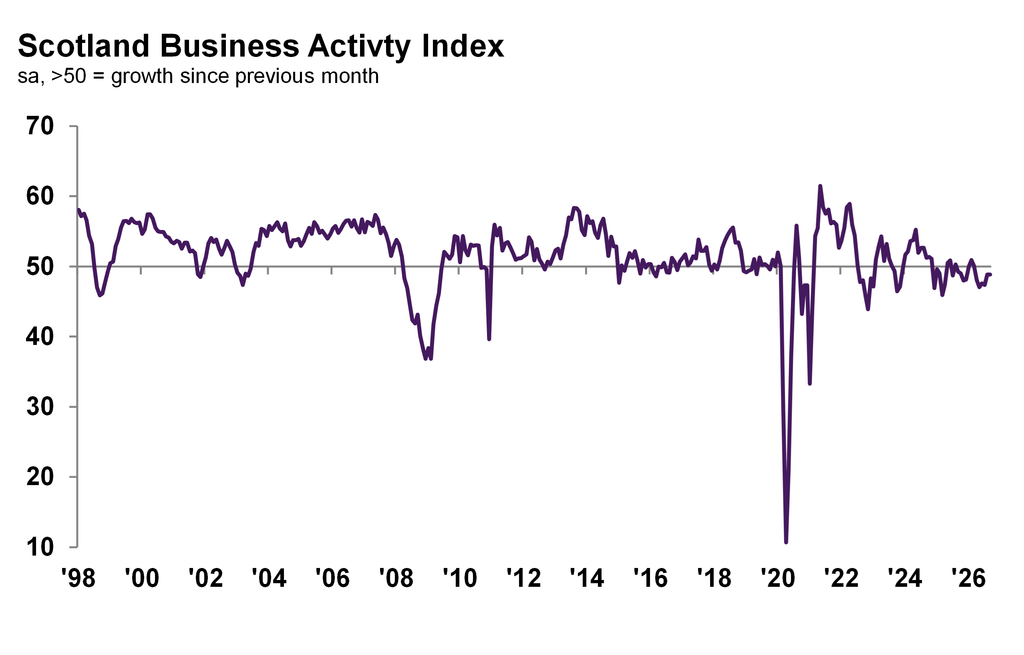
The headline figure is the Business Activity Index, calculated from a single question that asks for changes in the volume of business activity compared with one month previously. It is a diffusion index, which is the sum of the percentage of ‘higher’ responses and half the
percentage of ‘unchanged’ responses. It varies between 0 and 100, with a reading above 50 indicating an overall increase in compared to the previous month, and below 50 an overall decrease. The higher above 50, the faster the rate of growth signalled.
Performance in relation to UK
Scotland and the North West were the only two areas among the 12 monitored UK regions and nations to register declines in output, with Scotland posting the faster pace of reduction. Meanwhile, business activity growth across the UK as a whole eased to a modest pace that was the softest in three months.
Scottish private sector firms recorded a decline in new business during September, thereby extending the current run of decrease to two years. Panellists attributed the fall to a deterioration in demand conditions and higher costs for goods and services.
Meanwhile, new orders continued to rise at the UK level, although the rate of growth slowed from August and was marginal.
Expectations of better market conditions and stronger order pipelines supported optimism about output over the coming year, but overall confidence fell notably from the previous month. The respective index posted the second-lowest reading since December 2022, above only April 2026’s reading, as rising costs, the ongoing war in the Middle East and global uncertainty weighed on sentiment.
Among the 12 monitored UK regions and nations, only Northern Ireland expressed lower business optimism than seen in Scotland.
The pace of job creation across Scotland eased fractionally to a three-month low, but the upturn was the strongest among the 12 monitored UK regions and nations.
At the same time, the seasonally adjusted Outstanding Business Index remained below the neutral 50.0 threshold in September, signalling a fourteenth consecutive monthly fall in backlogs. Subdued inflows of new work enabled firms to reduce outstanding business, according to panellists.
Despite being slightly sharper than the UK-wide trend, the pace of backlog depletion across Scotland was modest and the weakest in the current sequence of reduction.
A marked and historically elevated increase in input costs was recorded across Scottish private sector firms in September. The pace of inflation was the most pronounced in three months, but below the peaks seen in April and May. Higher raw material, fuel and employment costs were cited by panellists.
The rate at which cost burdens rose at the UK level also quickened, and continued to outpace that seen across Scotland.
Prices charged for Scottish goods and services rose at the end of the third quarter. This generally reflected companies’ efforts to pass on higher expenses to customers, reports from survey respondents showed. That said, the rate of output price inflation eased since August and was the weakest of all 12 monitored UK areas.