
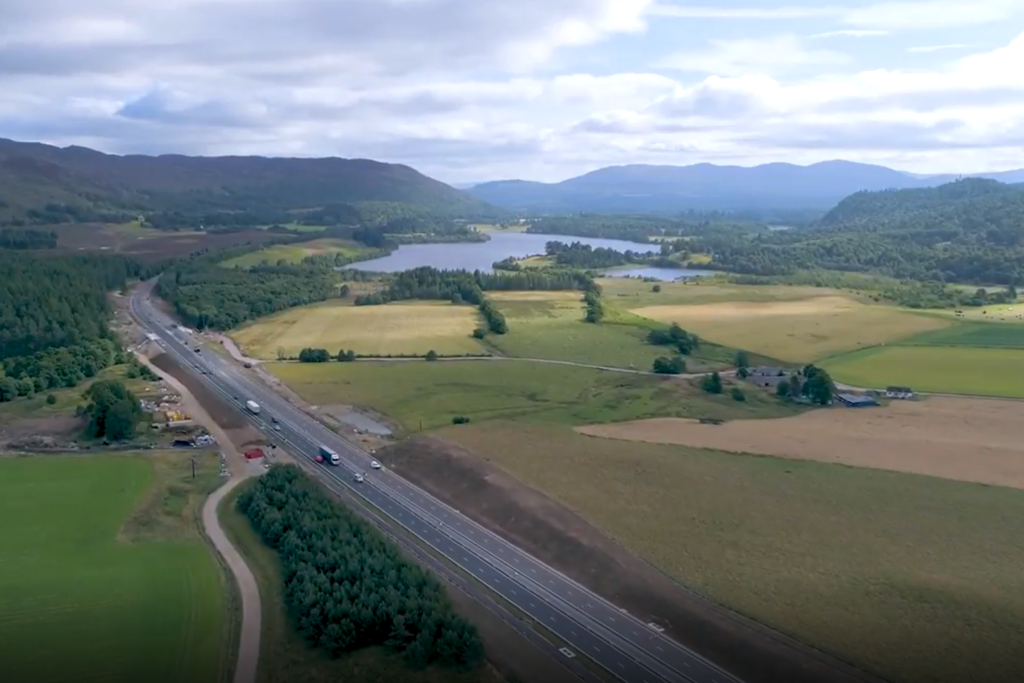
This week’s Scottish Government Budget delivered a mixed picture on two of the Highlands’ most consequential infrastructure priorities: the A9 and A96 dualling programmes.
In her budget statement on Tuesday, Finance Secretary Shona Robison reconfirmed the Scottish Government’s commitment to completing the dualling of the A9 between Perth and Inverness by 2035, backed by nearly £200 million of capital funding allocated in this year’s spending plan.
A9: Progress on delivery – but questions remain
The A9 dualling programme is one of Scotland’s largest transport infrastructure projects, with total costs now approaching £4 billion and significant parts of the route still single carriageway more than a decade after the first works began.
Transport Secretary Fiona Hyslop has set out delivery plans that will retain the 2035 completion commitment and shift to capital funded contracts after rejecting certain private financing options on “value for money” grounds. While this provides some assurance that the project will remain government funded, delays persist, and only a fraction of the route has been dualled so far in the face of complex procurement and market challenges.
There was welcome clarification in Holyrood that the critical Slochd to Dalraddy section – a stretch long criticised for congestion and safety issues – will now be completed a year earlier than previously planned, in 2032. However, other sections are now expected later, even if they remain within the overall 2035 deadline.
These shifting schedules underline the need for greater certainty on delivery milestones if Highland communities and businesses are to plan with confidence.
A96: Commitment reaffirmed — timetable and funding still missing
The reaction to the A96 in this Budget was more confusing and has sparked criticism beyond Highlands political circles. An infrastructure plan published alongside the Budget initially omitted any reference to the full dualling of the Aberdeen–Inverness road, referring only to improvements on “key sections”.
That omission provoked immediate pushback in Holyrood, prompting Robison to concede it was a production mistake in official documents and reaffirm that the government remains committed to full dualling of the A96, including sections such as Elgin and the Inverness–Nairn corridor.
While that clarification was welcome, no timetable or ring‑fenced funding for the full dualling was set out in the Budget itself – leaving local businesses, commuters, and communities without clarity on when key sections will progress from planning into active delivery. The project as envisaged – which would see around 138 km of single carriageway upgraded – is widely understood to require significant resources and long‑term financial planning given its scale and safety benefits.
Colin Marr, CEO, Inverness Chamber of Commerce, said,
“The Budget and subsequent transport debate give us a bit more clarity on the A9, and we welcome the accelerated timetable for the Slochd to Dalraddy section. That’s a real win for safety and connectivity in the north Highlands. However, while the Government has reaffirmed its commitment to full dualling of the A96, the absence of a clear delivery timetable and allocated funding makes it hard to take that commitment at face value. The economic future of the Highlands depends on modern, reliable, dual carriageway connections – and we need these to be planned, funded and delivered with the urgency they deserve.”
“We will continue to press the Government and Transport Scotland to provide a fully funded timetable for the A96 dualling and to ring‑fence the capital funding for completing the A9 by 2035. These are not optional luxuries; they are essential for safety, investment, and economic growth in our region.”
What comes next?
Transport infrastructure remains one of the most important drivers of economic opportunity for the Highlands – influencing business investment decisions, tourism connectivity and the day today lives of residents. The A96 is particularly important as it will connect the expanding renewables industry in the Highlands with potential supply chain businesses in Aberdeen.
As discussions continue over the next spending reviews and parliamentary debates, Inverness Chamber will be engaging with political representatives, local partners, and national officials to ensure these vital road projects are kept firmly on track and adequately resourced.