
In this article, HRI Munro Architects’ Director Andrew Bruce discusses the affordable housing crisis affecting the Highlands and Islands and suggests creative responses.
After the last war, there was a severe housing shortage. The then Labour government instituted a programme of prefabricated houses – ‘prefabs’ as they were known – which were essentially part modular, factory made units, to address this problem. It worked, accommodating thousands while a huge housebuilding programme got rolling. Many lived in prefabs for decades. They were essentially a stopgap solution but enabled people to be housed and communities to be formed and sustained. The huge post-war public housing boom which followed also worked, although that stock is now largely replaced or obsolete.
In the Highlands and Islands, the ‘Swedish timber’ house type was widely used and proved an effective medium and long-term accommodation solution; many are still in use and have often been ‘emblocked’ and upgraded. They were shipped as components in crates from Sweden with even the wooden crates being used in construction.
Then in the 1970’s and 80’s, Margaret Thatcher’s policy of selling off council houses largely destroyed the national stock availability for allocation and numbers have never fully recovered.
The creation of social housing stock and its subsequent selloff was a demonstration that determination and necessity, allied to the enormous power that can be wielded by government if it chooses to do so (as our generation learned in the response to the pandemic) can make things happen and solve (or equally create!) problems.
Making the weather
So our current and persistent rural housing problems aren’t some naturally occurring phenomenon like the weather; they are entirely a result of political choices made by politicians and therefore can be effectively addressed: if the political will exists to do so. Lack or unaffordability of housing in the Highlands and Islands is a significant issue which seriously impacts at all levels – socially, economically and culturally – and solutions must be found. The work of our Practice on social housing has shown that even the best designs result in high unit costs which effectively limit the numbers possible.
The shackles of convention
Local authorities and other social housing providers are locked into, and required to follow, a performance specification which is of significantly higher quality than any private mass housebuilders; rightly so perhaps, but this means that costs per housing unit generally exceed £200k. If land acquisition costs are added, this can reach unaffordable levels or simply limit numbers.
They are similarly bound to ‘traditional thinking’ and rigorous planning restrictions in terms of areas, roads, house types and capacities etc. All those involved in housing development know of the ever-increasing amount of regulation, restriction, policy frameworks and compliance costs.
Given the restricted (and shrinking) government funding available, it’s simply not possible to meet demand effectively on this basis, no matter what political promises are made. The likely demise of the Highland Housing Trust due to ‘challenging’ financial restrictions is simply another sign of political failure.
Along with restricted availability and high costs of rural sites (with effective land reform seemingly stalled, another fundamental government failure), holiday accommodation outpricing rentals, inflating prices and a seeming inability or unwillingness by local and national politicians to promote more radical solutions for fear of offending powerful lobbies or compromising other areas, it’s perhaps not surprising that there’s a ‘stubborn crisis’, a second highland clearance if you like, which is impacting most areas of Highlands and Islands life and risks our future prosperity and growth.
Options for a new approach
As architects, we are actively engaged with clients and collaborators in exploring creative alternatives, be this in different construction methods, adapting urban housing densities to rural settings, challenging accepted thinking on vehicle access requirements or reviewing how housing standards should be changed to address financial realities.
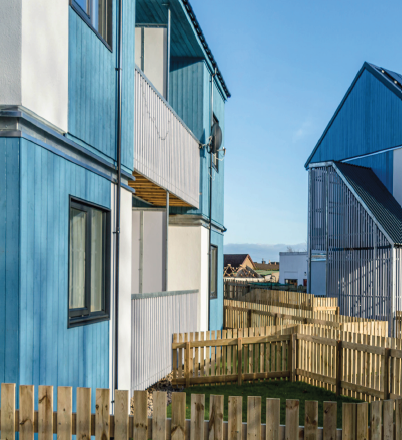
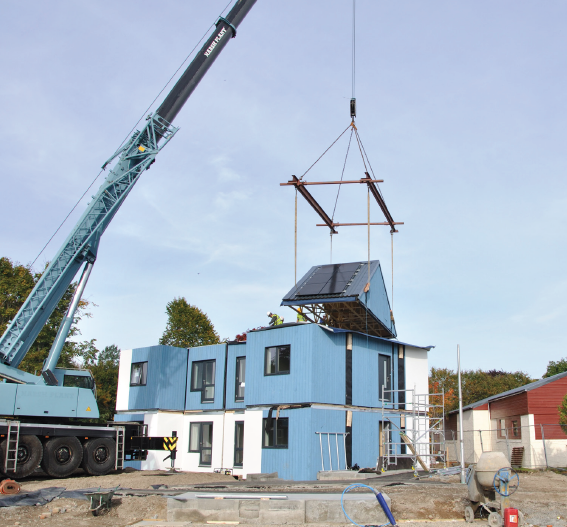
One possibility for new thinking is what’s called a ‘volumetric’ approach; houses factory assembled as completed factory-built modules, trucked to the site and lifted into place. Our JNESpace modular housing development, designed years ago for the Highland Council in Alness but never repeated, demonstrated that a fully modular, off-site assembly approach worked and could deliver real benefits. We are now looking to develop smaller, semi-modular units for different occupancy types. This modified volumetric system is known as an MMC (modern methods of construction) approach, with housing units factory build in panels for site assembly. Other suppliers, notably MAKAR homes in Inverness, are doing good work in seeking to make MMC based housing more affordable.
Interestingly though, mass modular housing has not been shown to deliver real economies. Significant investment in plant and factory facilities has tended to offset unit savings.
Opportunities for creative collaboration
There are multiple strands to the problem; land availability, financial models, building standards, simplifying the planning process, effective and responsive procurement and a reduction in the multiple regulatory and bureaucratic hurdles which slow or halt the process.
Similarly, there are multiple attempts to address these problems and restrictions, but too often these initiatives are ‘siloed’ – and sometimes made purely for political advantage or publicity – without effective engagement of other key participants in the process.
What is not at issue is the fact that effective solutions MUST be found; if not we risk the effective social, economic and cultural future of the Highlands and Islands.
We would suggest a middle way, a ‘21st century prefab policy’ to provide comfortable, energy efficient homes for people which can be completed for £150k per unit. A modified MMC approach might well be worth pursuing. Pragmatic, creative and ‘can do’ approaches are necessary, a real collaboration between architects, contractors, developers and politicians in local and national government, to design and enable solutions and get this done.
Making it happen: a creative strategy forum
Addressing and solving the housing crisis needs real and creative engagement – and a degree of risk taking – from all the parties involved in procurement, design, construction and funding. That must include legislators and building standards officials. At root this is a political issue which needs brave politicians to lead; but we can envisage a creative strategy forum with open minded participants from all the stakeholders – including cross party politicians – willing to challenge conventional thinking to find solutions.
Architects are (or certainly should be) visionary thinkers; we spend lots of time exploring and illustrating potential with an inherent holistic approach to problems. Our profession in the Highlands and Islands might consider taking a real lead in promoting and facilitating such a ‘creative strategy forum’, bringing all the stakeholders together in a freethinking, non-confrontational setting to frankly discuss the problems and suggest ways forward. In doing so, I believe we would be pushing at a door which can certainly be opened.
For further information, contact Andrew Bruce: andrew@hri-architects.com / info@hri-architects.com