

The latest Royal Bank of Scotland Growth Tracker indicated that business conditions across Scotland’s private sector moved closer to stabilisation in August.
The headline Royal Bank of Scotland Business Activity Index – a seasonally adjusted index that measures the month-on-month change in the combined output of Scotland’s manufacturing and service sectors – rose to 48.9 in August from 47.3 in July. The latest reading signalled only a modest fall in private sector activity. Where activity fell, firms often attributed this to subdued market conditions and fewer new orders.
Private sector firms in Scotland recorded a third successive monthly rise in employment during August. The pace of job creation was broadly unchanged from July and was among the strongest recorded over the past two years. Respondents often linked the latest rise to company expansion plans, new projects and efforts to replace leavers.
Commenting on the Tracker’s findings, Judith Cruickshank, Scotland Board Chair, Royal Bank of Scotland [headline picture], said, “The latest data for Scotland present a mixed picture for August, albeit one that is more positive compared to recent months. The economy is showing tentative signs of improvement, with business optimism climbing to a six-month high and the pace of decline easing in both output and new orders.
“Employment remains a clear source of strength. Sustained job creation, despite challenging demand conditions, suggests that firms’ improved confidence is feeding through to hiring activity, with payrolls being lifted in anticipation of new projects and expansion plans.
“The inflationary picture remains challenging, but the direction of travel is encouraging. Cost pressures are easing and, if that continues, we could see price increases begin to moderate in the months ahead.”
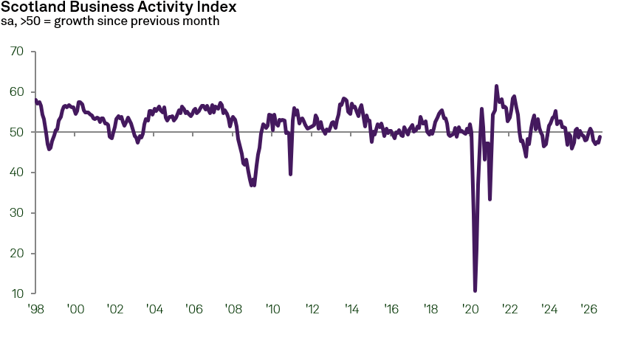
The headline figure is the Business Activity Index, calculated from a single question that asks for changes in the volume of business activity compared with one month previously. It is a diffusion index, which is the sum of the percentage of ‘higher’ responses and half the
percentage of ‘unchanged’ responses. It varies between 0 and 100, with a reading above 50 indicating an overall increase in compared to the previous month, and below 50 an overall decrease. The higher above 50, the faster the rate of growth signalled.
Performance in relation to UK
Among the 12 monitored UK regions and nations, Scotland was one of four areas to record a fall in output, with its decline the steepest overall. In contrast, business activity rose across the UK as a whole.
New orders across Scotland’s private sector fell again in August, extending the current run of contraction to nearly two years. Anecdotal evidence linked the latest fall to a general market slowdown, ongoing geopolitical uncertainty around the Middle East, higher utility costs and subdued demand conditions.
Across the UK as a whole, new orders rose at a slower and only marginal rate.
At the same time, Scottish firms became increasingly confident about activity prospects over the next 12 months. The level of optimism rose further from April’s recent low to a six-month high, but remained weaker than the UK average. Firms hoped that continued investment in new equipment and new contract wins would help to drive growth.
Alongside Scotland, staffing levels also rose in the South West of England, thereby indicating that only two of the 12 monitored UK regions and nations reported higher payroll numbers in August, as reductions were recorded elsewhere.
At the same time, Scottish firms continued to report limited pressure on capacity, as backlogs of work fell for the thirteenth consecutive month in August. Panellists attributed the latest decline to weak inflows of new business.
The rate of backlog depletion across Scotland slowed since July, but was slightly faster than that recorded across the UK as a whole.
August data indicated a further substantial rise in input costs faced by Scottish firms. However, the pace of inflation did ease for the fourth straight month to the weakest since February. Scottish companies highlighted greater outlays on raw materials, including steel, fuel and transport, which were partly linked to the conflict in the Middle East.
That said, cost pressures across Scotland were the weakest of the 12 monitored UK regions and nations.
Meanwhile, Scottish businesses raised their prices at a sharper rate in August. The increase in selling prices was linked to the pass-through of higher input costs to clients.
At the UK level, the pace of inflation also gathered pace and remained stronger than that seen in Scotland.