
NatWest/ Royal Bank of Scotland and Beauhurst’s New Startup Index published today shows the UK’s active business population continues to grow as entrepreneurs adapt to a changing business environment.
- 402,000 new companies incorporated across the UK in H1 2026
- Active company base grows to 5.66 million businesses
- Startup activity continues across every UK region, with Scotland recording the strongest growth
- Application software startups increase 40% year-on-year, highlighting the strength of the UK technology sector
The UK’s active business population has reached a record 5.66 million companies, demonstrating the strength and adaptability of British entrepreneurship despite a moderation in new company incorporations, according to the latest New Startup Index.
A total of 402,000 new businesses were registered with Companies House in the first half of 2026, a 5.7% decrease compared with H1 2025. However, entrepreneurial activity remained widespread across every region of the UK, with the continued growth in the active company base providing evidence of the resilience of the UK business landscape.
Technology businesses were a standout performer during the first half of the year. Application software became the UK’s most active startup category with 28,100 new businesses incorporated. The wider digital and technology sector also recorded strong growth, reflecting continued innovation and investment in areas such as AI and emerging technologies.
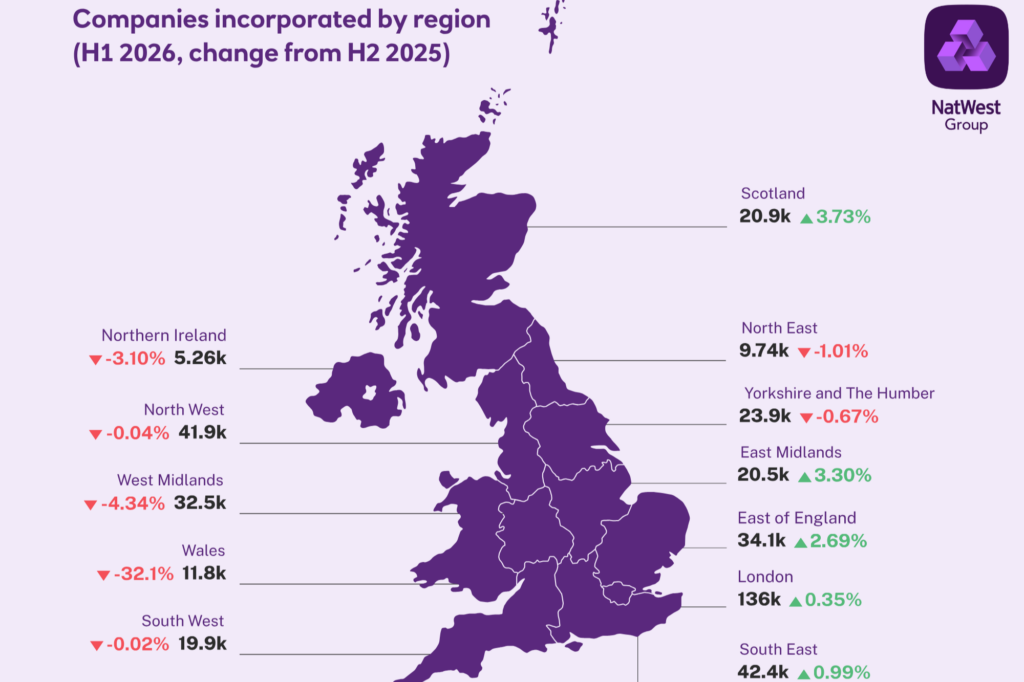
Regional entrepreneurship also remained vibrant. Scotland recorded the strongest growth in startup activity, with incorporations rising 3.73% compared with H2 2025 to 20,900.
While incorporation volumes have adjusted compared with previous years, the data suggests regulatory reforms may be contributing to a higher-quality company register by reducing low-intent and fraudulent registrations.
Darren Pirie, Head of Accelerator and Strategic Partnerships at Royal Bank of Scotland, said, “The latest data shows UK entrepreneurship remains in good health. While startup formation has moderated, more businesses are operating across the UK than ever before and founders continue to identify opportunities for growth, particularly in high-potential sectors such as technology and software. The strength of entrepreneurial activity across every region of the country underlines the important role new businesses play in supporting innovation, investment and local economic growth.”
Sebastian Burnside, Chief Economist for Royal Bank of Scotland, said, “Britain’s start-up economy is adjusting, not retreating. While incorporations eased in the first half of 2026, the active company base has continued to grow, showing the underlying resilience of UK entrepreneurs against a turbulent backdrop. The shift towards software and digital businesses is especially striking and speaks to the economy’s changing centre of gravity as technology transforms what we do and how we do it. This underlines the importance of backing the founders who are driving those opportunities wherever they are, connecting them to the right support, and helping turn ambition into long-term growth.”
Founder view: Pounce Padel from Edinburgh
Pounce Padel designs and manufactures high-performance padel rackets tailored specifically for women, with a mission to help more women move, play and enjoy the sport.
The business was launched 7 months ago by founder, Georgie Rennie, who won the Royal Bank of Scotland Accelerator Pitch competition in April 2026. She scooped the top prize of £15,000 after impressing a panel of industry experts at the opening of the bank’s new Accelerator hub in Edinburgh. The business will use the prize money to expand into children’s equipment, aiming to encourage more young girls to take up padel and build skills early.
Georgie Rennie, Pounce Padel Founder, said, “I’m only seven months into launching Pounce Padel, so the pace of the last year still surprises me some days. But the biggest surprise as a startup has been the support I’ve received. People I’ve never met have reached out on LinkedIn and Instagram wanting to back the business, following the journey and cheering me on.”
“I’m proud to have been able to set up my business in Scotland. Scotland has a real entrepreneurial energy. What stands out about Scotland’s start-up community is its collaborative spirit. Founders are prepared to think big, but they are also generous with their experience and connections. With continued access to finance, expert coaching and networks, hopefully myself and other Scotland based entrepreneurs can continue to build businesses that are successful both within and beyond the domestic market.”
Founder view: Cyber Thistle from Glasgow
Cyber Thistle drives cybersecurity innovation, delivering secure, seamless solutions. We protect vulnerable groups and businesses with advanced behavioural biometrics and next-generation security, making digital safety simple and trusted.
Anisha Fernandes, Cyber Thistle Founder said, “Turning complex technology into a scalable product comes with unique funding and development challenges, but the strength of the local ecosystem, along with tailored support and a resilient network in Glasgow has been vital in helping us navigate that journey at Cyber Thistle. But also looking ahead, targeted investment and supportive policy in Scotland will be critical to empowering high-growth, technology-led businesses to scale internationally.”
The Royal Bank of Scotland supports startups and scaleups through a range of initiatives, including access to funding, specialist business expertise, mentoring, networks and entrepreneurial programmes designed to help founders start, scale and succeed.