
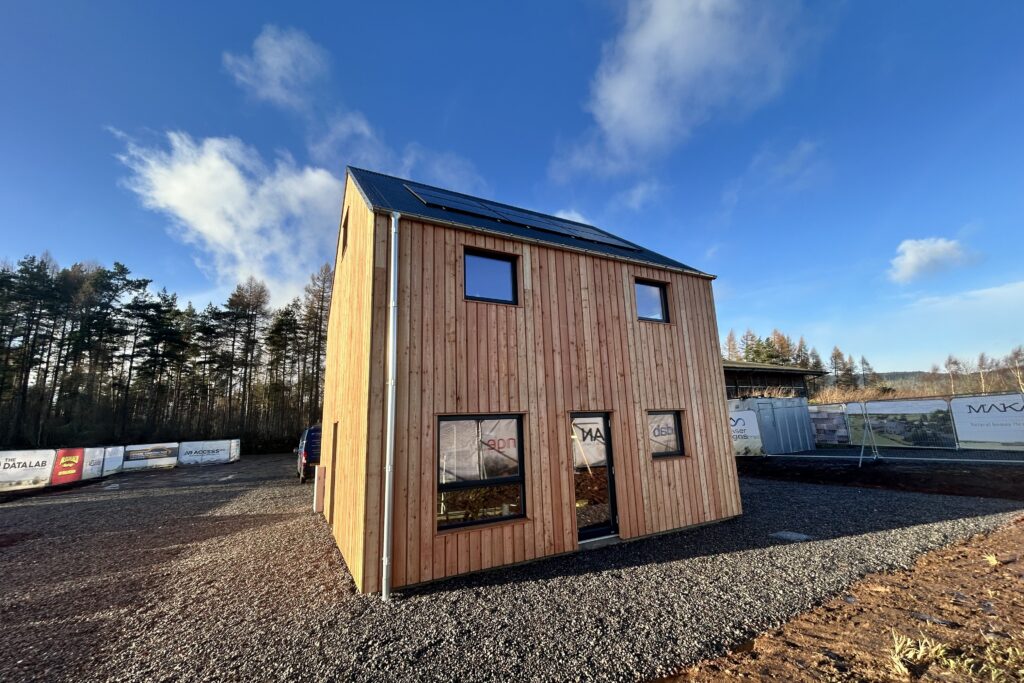
Despite snow, frost and rain, this pioneering two-bed prototype home in Inverness was rapidly assembled in just one week. MAKAR has set out to prove there is a better way to build affordable homes, one that keeps heating costs low, removes the risk of damp and mold, and uses homegrown Scottish timber.
CEO Neil Edgar says, “We need to eradicate the issues of damp, high heating costs, and fuel poverty as conventional new builds continue to fail us. What if we could build healthy and affordable homes that people actually want to live in? It is time Scotland built better homes that provide warmth, protect health and offer true affordability, all in one product. That sounds quite simple, but it takes decades of experience and determination to break through the business-as-usual approaches currently adopted.”
Traditional new build construction times in the UK are around 7–10 months. Using Modern Methods of Construction, MAKAR has assembled a home to pre-fit out stage in a week. In a time of acute housing crisis, this off-site precision-manufacturing approach offers rapid deployment of affordable homes across the UK, including the Highlands and Islands, while ensuring safer and more predictable working conditions, considerably less waste, and lower build costs. The affordable home solution is priced from £128K each, when purchased as a group of 12 manufactured homes that are delivered and assembled to Wind and Watertight stage.
This prototype home will be used to showcase the future of social housing in Scotland, with ‘breathing walls’ that prevent the risk of damp or mold. The home is built from natural materials and is designed to tackle fuel poverty with low heating costs modelled at £5-7 a week. The affordable homes will also support rural jobs and local supply chains in forestry, timber processing and construction. 27 key suppliers supported this project to help highlight the need for better affordable homes.
By 10am on Monday 17th November, just two hours after Stoddart’s crane lifted the first panel, all the precision-manufactured wall panels were slotted seamlessly together. By Tuesday afternoon, the attic and roof panels were in position, the crane had left the site, and the external structure was being complete while the internal walls and floors were being structurally screwed off. By the end of week one, the team had fully assembled the home to pre-fit out stage (Wind and Watertight), including roof coverings, windows and doors installed and solar PVs on the roof.
An external organisation will collect data on this prototype over 15 months, to verify energy usage and confirm the costs to keep the home heated through two winters.